ServicesGutters
Gutters in Bellefontaine
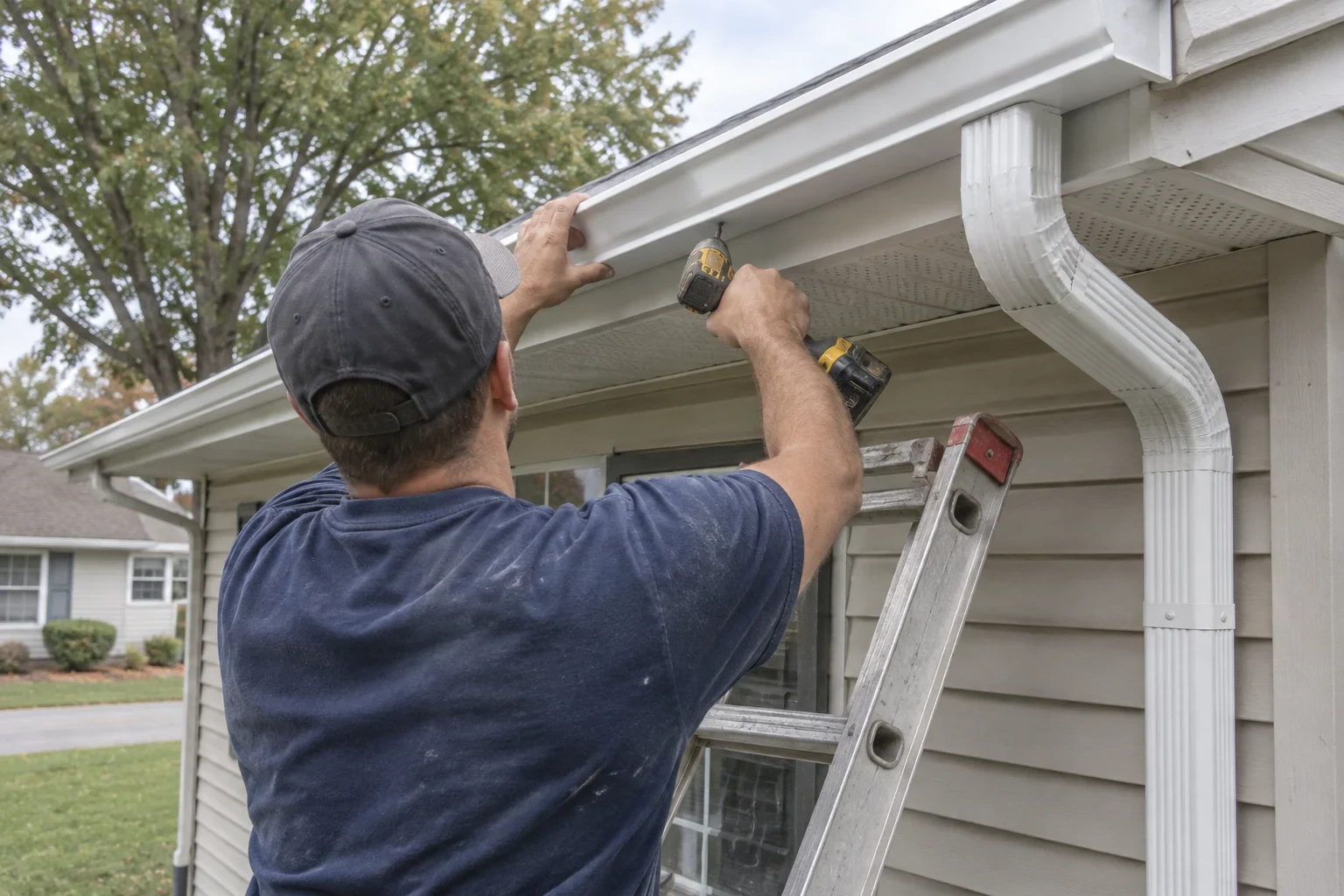
We form continuous aluminum gutters on site, size the trough and downspouts to the roof above them, and set the slope so every run empties. Screw-in hangers carry snow and ice through winter, and water ends up away from your fascia and foundation.
The Job Your Gutters Do
Rain leaves your roof in a set order: down the shingles, across the drip edge, into the trough and through the downspouts to the ground. When one link in that chain is too small, too flat or loose, water pools behind the gutter, wets the fascia board and pours straight down along the foundation.
Three faults account for most of the problems we find. Troughs hung with too little slope hold water, spike-and-ferrule fasteners loosen over time, and downspouts are often too narrow for the roof area they serve. A new system only corrects those faults if it is measured and fastened with care, so that is where our time goes.
Our preferred window is late summer through early fall. Gutters installed before leaf drop and the first hard freeze go into winter ready for the months that strain them most.
Every Gutter Job Includes
Runs formed from coil at your home
A roll-forming machine shapes aluminum coil into gutter right in your driveway, and each run is cut to the measured length of that eave. Without joints along the straight stretches, the only connections are corners and end caps, and those are the spots we seal and inspect.
Capacity matched to the roof
A 5-inch K-style trough suits most one-story roofs. When a big or steep plane empties into a single run, we usually step up to 6-inch gutter with 3x4 downspouts in place of 2x3, so a heavy spring downpour does not overflow it.
Concealed hangers and a measured slope
Hidden hangers are screwed into the fascia at close spacing to handle snow weight, instead of spikes that loosen after a few winters. We set the fall at about a quarter inch over each ten feet, enough to move water to the outlet without leaving puddles in the trough.
Drip edge and apron at the eave
If water slips behind the gutter, the fascia rots. We make sure the drip edge or a gutter apron extends into the trough and install flashing wherever it is absent.
Downspout placement and outlets
We position downspouts where they can empty without obstruction and add elbows or extensions that carry water several feet past the foundation, keeping it off walkways and drives where it would turn to ice.
Tear-off and haul-away
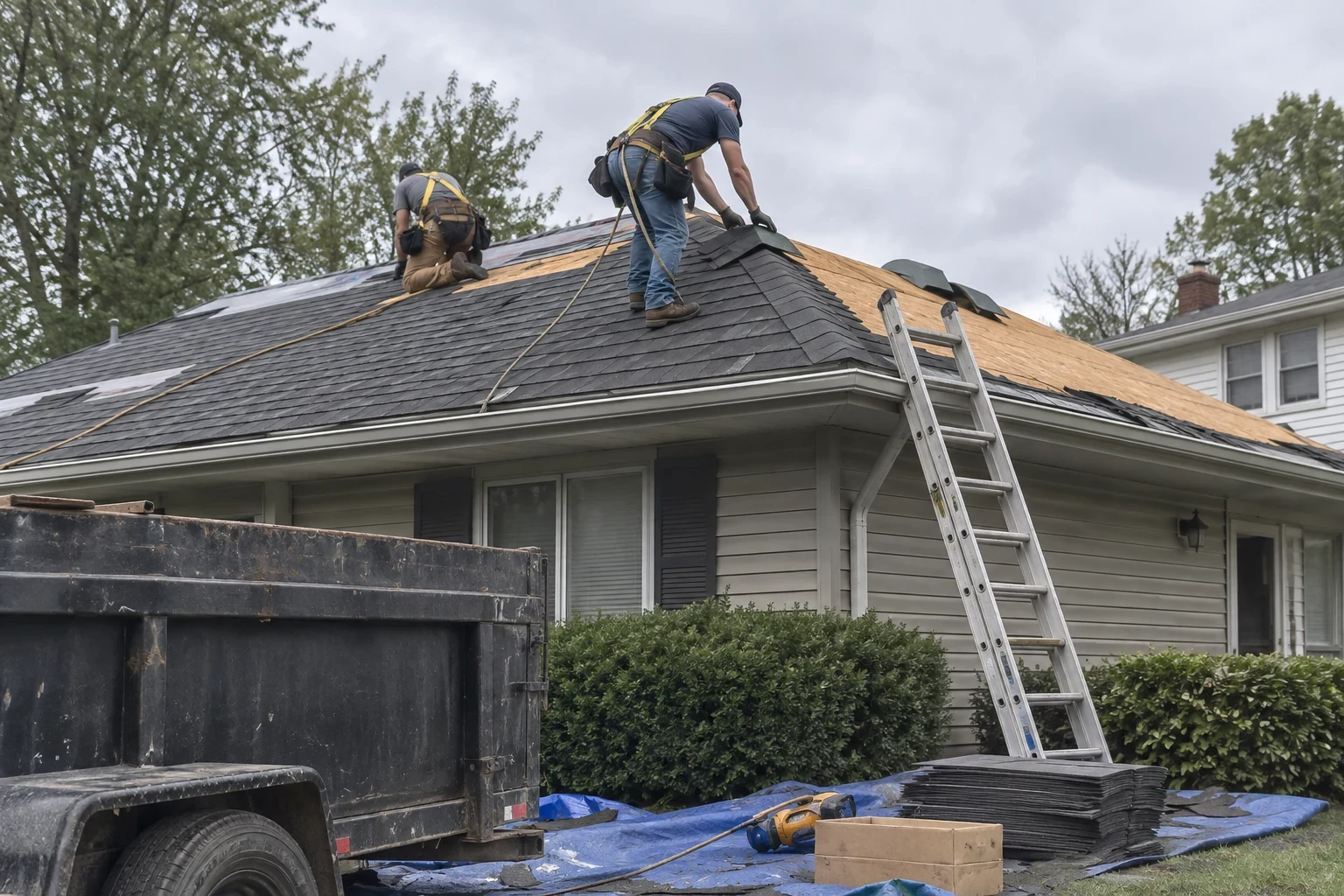
The old trough, hangers and downspouts come down and leave with us, and we sweep beds and lawn for stray fasteners and debris before we go.
Warning Signs at the Eaves
- Overflow during ordinary rain
- Clean gutters that still spill over the lip in a steady rain are too small, sloped incorrectly or feeding a downspout that is undersized.
- Dips and gaps at the fascia
- A section that sags between fasteners collects water and ice. That weight loosens the hangers and can pull the fascia board off with them.
- Staining or soft wood at the roof edge
- Streaks, flaking paint or spongy fascia mean water is getting behind the trough. Eventually the board rots and the gutter loses its anchor. Our soffit and fascia page explains that repair.
- Drips at joints and corners
- Sectional gutters usually fail at their joints first. If seams keep dripping after the rain has stopped, the sealant there has worn out.
- Heavy icicles along the eaves
- Thick ice in the trough is often a sign that water is standing instead of draining. That ice also loads the hangers, which is how many gutters end up bent by spring.
- Eroded soil or a damp basement corner
- A washed-out patch under a downspout or moisture in one basement corner usually points to water being released too near the foundation.
Gutter Installation, Step by Step
- 1
Site visit and eave check
We tape every run, note the roof pitch and how much roof drains toward each corner, and probe the fascia for soft wood. If the drip edge or roof edge needs repair, you hear about it before any material is ordered.
- 2
Itemized estimate
The estimate lists trough size, downspout size and count, any fascia work and removal on separate lines, along with photos of the conditions we found.
- 3
Removal and a second look at the fascia
Install day starts with the old trough coming down, then we check the bare fascia once more, since rot tends to hide where the gutter sat. If the damage runs further than we expected, you see it first and no board is replaced until you have.
- 4
Forming, hanging and water test
Gutter is rolled out on site, hangers go in, the slope line is chalked, and each run gets a hose test to confirm it drains to its outlet.
- 5
Finish work and cleanup
Downspouts and extensions are attached, corners and end caps are sealed, and the yard is cleaned up. Most houses are finished in one day.
What Sets the Cost of New Gutters
Most gutter pricing comes down to two things: the number of feet of trough your home needs and how hard the eaves are to reach. We price from a tape measure at your home, not a guess from the curb. Any fascia repair is listed as its own line, so you can see exactly what it adds.
- Footage and number of corners
- More linear feet means more coil and more hangers. Every inside or outside corner is a mitered joint that is cut, fitted and sealed by hand, so a house with many jogs costs more than a plain rectangle.
- Trough and downspout dimensions
- A 6-inch trough with 3x4 downspouts takes more aluminum than 5-inch gutter with 2x3 spouts. On large or steep roof planes, that added capacity is usually money well spent.
- Eave height and what sits below
- Second-story eaves, sloped lots, decks and planting beds under the drip line all change where ladders can stand and how long each run takes to hang.
- Fascia condition
- Hanger screws need solid wood to bite into, which means any rotted fascia board is swapped out before the new trough goes up. Decay frequently hides behind an old gutter and only shows once it is removed, so we tell you ahead of time what could turn up and how that work would be priced.
Gutter Questions We Hear Often
- Do one-piece gutter runs beat sectional gutter?
- Usually, yes. Sectional gutter has a joint about every ten feet, and any of them can begin leaking when the sealant dries out. A one-piece run only has joints at the corners and end caps, so there are far fewer spots for water to escape.
- Is a 5-inch gutter enough for my roof, or should I go 6-inch?
- That comes down to how much roof area feeds each run and how steep it is. Rain sheds quickly off a steep roof, and in a heavy storm it can overflow or jump a 5-inch trough. After we measure, we suggest a size and tell you why.
- When is the right season to replace gutters?
- We prefer late summer into early fall, so the new gutters are hung before the leaves drop and before freeze and thaw start working on hangers and corners. Spring, ahead of the rainy months, is a good second choice.
- Should I get gutter guards?
- It hinges on your trees. With big branches over the roof, guards greatly reduce clogs. With little canopy above, a properly sloped gutter cleaned once or twice a year generally works fine, and we will be honest about which describes your home.
- Can I replace gutters and keep my current roof?
- Yes, plenty of gutter jobs stand alone. If your shingles are near the end of their life, we may recommend doing both at once so the drip edge goes on just one time. Our roof replacement and roof inspections pages explain that part of the choice.

Have New Gutters Up Before the Leaves Fall
Describe what is happening along your roof edge and we will book a visit to measure, look over the fascia and explain the size and layout that suit your home.